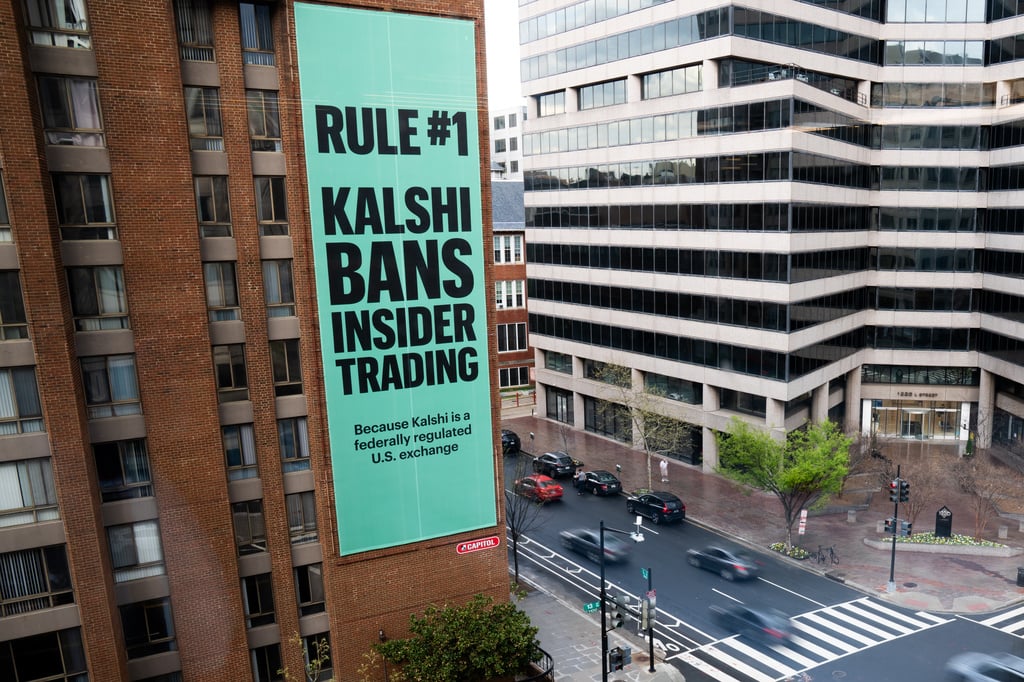
The Commodity Futures Trading Commission scored a major victory on behalf of Kalshi and other prediction markets when the United States District Court for the District of Arizona granted its motion to temporarily restrain the state’s Attorney General from prosecuting event contracts listed on Kalshi and other CFTC-regulated designated contract markets.
The ruling came on the eve of Kalshi’s scheduled initial appearance in criminal court on Monday in Maricopa County, which will no longer take place.
CFTC Chairman Mike Selig praised the move in a statement:
“The CFTC appreciates the court’s careful consideration of these important legal questions and the court’s decision to preserve the status quo. Arizona’s decision to weaponize state criminal law against companies that comply with federal law sets a dangerous precedent, and the court’s order today sends a clear message that intimidation is not an acceptable tactic to circumvent federal law.”
TRO: CFTC likely to succeed on preemption claims
In ruling in favor of the CFTC, the court determined that the commission “has made a clear showing that it was likely to succeed on the merits of its claim that Arizona’s gambling laws are preempted by the Commodity Exchange Act.” In doing so, the court acknowledged the recent decision rendered by the U.S. Court of Appeals for the Third Circuit (KalshiEX, LLC v. Flaherty) that event contracts fall under the Commodity Exchange Act’s definition of “swaps,” adopting the view that if “event contracts are swaps under the Act,…the scope of field preemption [is] the regulation of trading on a DCM.”
Though sports-related and political event contracts remain the main topic of discussion, the order does not attempt to subcategorize, instead simply relying on the statutory definitions set forth in the CEA. As the appellate court stated in Flaherty:
As always with statutory interpretation, “we begin with the text.”… The [CEA] provides that the relevant event or occurrence need only be “associated with a potential financial, economic, or commercial consequence.” … As the dissent concedes, “[a] plain reading of the Act’s text suggests that Kalshi’s sports-event contracts fit comfortably within the statutory definition.” … That is correct. The outcome of a sports event certainly can be associated with a potential financial, economic, or commercial consequence.
The District Court did not clearly err when it identified numerous affected stakeholders, including sponsors, advertisers, television networks, franchises, and local and national communities. The analysis need not go further. Because Kalshi’s sports-related event contracts are traded on a CFTC-licensed DCM and depend on event outcomes associated with economic consequences, they fit within the Act’s definition of “swaps” subject to the CFTC’s jurisdiction.
Hearing scheduled for May 6
The order expires April 25, and hearing on the CFTC’s preliminary injunction is scheduled for May 6.
The order states that Arizona is “enjoined and restrained from enforcing Arizona’s gambling laws, A.R.S. §§5-1301 et seq., through any criminal or civil enforcement actions related to event contracts listed on CFTC-regulated DCMs.”
This is the latest step in a case that could impact prediction market litigation moving forward:
- Arizona and Kalshi initiate legal action against each other, with (i) Kalshi filing a federal complaint for permanent injunction and declaratory relief, and (ii) Arizona filing state criminal charges relating to Kalshi’s offering of sports-related and political event contracts.
- Based on Arizona’s filing of criminal charges in state court and the federal court’s application of the Anti-Injunction Act, which prohibits federal court remedies that may interfere with state judicial proceedings, Kalshi’s motion for preliminary injunction preventing Arizona from enforcing state gambling laws was denied without addressing the merits of Kalshi’s preemption arguments.
- The CFTC filed its own federal complaint for permanent injunction and declaratory relief against, among others, Arizona, and had its case was consolidated with Kalshi’s.
- The CFTC filed its own motion for temporary restraining order and preliminary injunction allowing the court to address preemption arguments due to the CFTC being the party requesting the relief.
Key predictions hearing on Thursday
In the meantime, one of the most important hearings to date is scheduled to take place Thursday when the United State Courts of Appeals for the Ninth Circuit – which includes Arizona – hears oral argument on the each of the following cases:
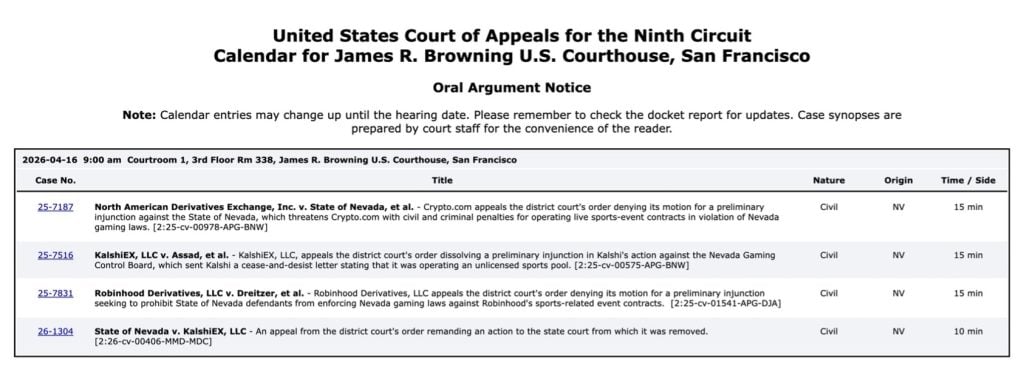
The outcome of this hearing will likely have significant impact on whether the CFTC is victorious in preliminarily enjoining further state action, not only in Arizona, but also in other states in which it seeks to protect its exclusive jurisdiction over prediction markets.